Stories from past and present showing the ordinary and extraordinary lives of our local military veterans community.

17778 Private Albert Alexander HUGHES

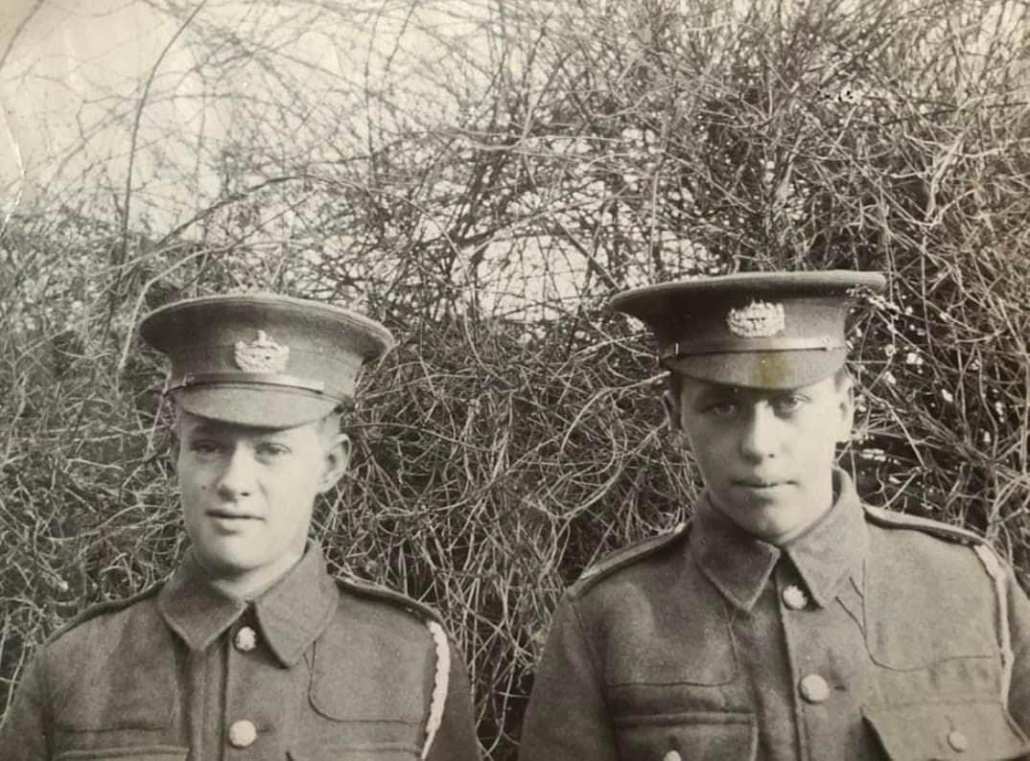
17777 Private Harry HUGHES

2ndBattalion (A Company), Gloucestershire Regiment

Aged 18 and 19. 

Killed in action on 9 May 1915

No known grave–commemorated on the Menin Gate Memorial to the Missing

The stories of the Hughes brother are virtually inseparable. Albert Alexander, known as ‘Alex’, was the elder of the two, having been born in Paddington, London in 1896. Harry was born at Chelsea, London in the following year. They were the sons of George A and Annie E Hughes (nee Harding) of The Wye, children and had six other siblings.

Prior to enlisting in the Army in January 1915 both were mill hands. Their Army numbers are consecutive which indicates they both signed up at almost exactly the same time. It is likely that one or both lied about their age, in order to avoid being held back in the UK until they were 19.

They were posted the 2nd Battalion of the Glosters, which had been sent to join the BritishExpeditionary Force (BEF) in France in mid December 1914. The Hughes boys arrived in France on Good Friday, 2 April 1915, as part of a draft to replace casualties. They were both assigned to ‘A’ company.

In late April the 2 nd Glosters were deployed just south of the Menin Road, near to the village of Hooge, in what was known as ‘The Ypres Salient’ in the front line, facing the Germans in Herenthage Wood. The town of Ypres had tremendous strategic importance and was subjected to heavy fighting throughout the Great War. Its importance lay in the fact that it if it fell the route to the Channel ports, vital to thesupply of BEF, would be open to the Germans.

During April and May 1915 the Germans mounted a series of attacks in the Ypres Salient, which formed part of what became known as The Second Battle of Ypres. By 9 May the British units had been forced to give ground and were entrenched on the eastern edge of Sanctuary Wood, facing a German strongpoint named Stirling Castle. Both 8 and 9 May had seen the British subjected to heavy artillery bombardment and heavy fighting ensued. It is possible that the Hughes brothers took part in a British counter attack which went in at 3.30pm on the 9th, which was subjected to heavy machine gun fire from parts of Sanctuary Wood and Stirling  Castle. On the 9th the 2ndGlosters lost 5 officers and 140 other ranks, killed wounded or missing. It is almost certain that the Hughes brothers were part of the 140. The Dursley Gazette reported that one of their comrades sent a letter to his parents in Wotton-under-Edge in which he spoke of ‘seeing the Hughes boys bowled over’ which was conveyed to the boys’ parents in Charfield.

The Hughes brothers enlisted, served and died together on the same day. If their bodies were recovered they were probably buried locally, only to be disturbed in the subsequent fighting in the area. They are commemorated, together, on the panels devoted to the Gloucestershire Regiment located on the Menin Gate Memorial to the Missing of the Ypres Salient. 

Their brothers Joe and George Hughes also served in the Great War (with the Army Service Corps and Glosters, respectively) and survived. 

The idea of a Charfield memorial was first raised by their brother, Joe, in early February 1919, in a letter to the local newspaper. The village Parish Council took up the administration of the task and a committee was set up to gather subscriptions for costs and the manage the work itself. The final cost was around £200 (around £6500 today).

Work on building the Memorial commenced soon after, with Mr W. T. Goscombe, a local contractor being employed. The centre piece took the form of a Portland stone Gloucester Cross, with the names of the fallen inscribed at the base. Panels on the surrounding wall listed the names of others who served.

Although completed at the end of September 1919, the formal dedication did not take place until 2.45 pm on 28th February 1920. A large crowd gathered. Amongst it were many relatives of the fallen, who were later to place floral tributes. Over the Cross was draped a large Union Flag and the task of removing this was given to Frances Beatrice Neal, the only child of the village rendered fatherless by the War – her father went down with HMS Monmouth at the Battle of Coronel in November 1914.

Thanks to Alexis Threlfall, Graham Adams and others for the information in this and photographs.
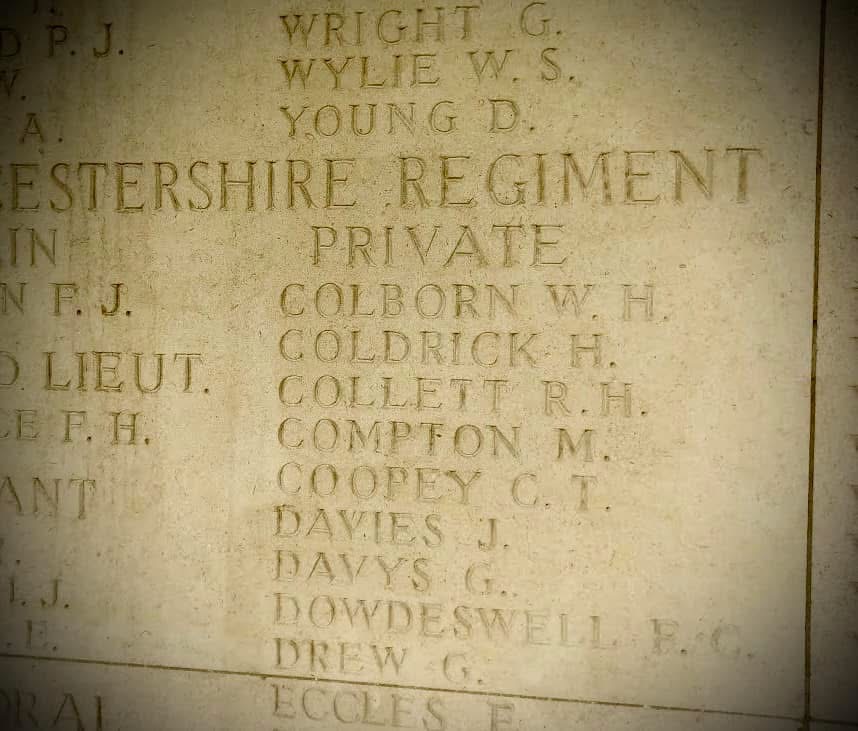
741 Private William Henry COLBORN

1st Battalion, Gloucestershire Regiment

Died aged 26 as a prisoner of war 23 December 1914

No known grave – commemorated on the Le Touret Memorial, France

William Colborn was born in Charfield in 1888, the eldest of nine children born to George and Hannah Colborn of Station View, Charfield.

In the 1911 Census he is shown as being a ‘general labourer’ and given his low Army number and the fact that he served with the 1st Battalion of the Gloucestershire regiment, he may well have had some military experience prior to the start of the Great War.

Unfortunately, no Army Service record has survived by his Medal Index Card does show that he first landed in France on 11 September 1914, which was about a month after the 1st Glosters were first deployed there, as part of the British Expeditionary Force.

He would have joined the 1st Glosters just as the tide was turning in favour of the British and French forces, following the long retreat from Mons to the River Marne. 

Pte Colborn was reported as ‘wounded and missing’ in the War Office Casualty List published in newspapers, such as the Gloucester Journal, in March 1915. 

However, it would appear that he was taken prisoner, probably whilst fighting was taking place in the area between Bethune and Armentieres and possibly died of wounds shortly after, as the records of the International Committee for the Red Cross do not contain evidence of incarceration in any prisoner of war camp. It must have been established that he died on 23 December 1914, aged 26 and was probably buried locally by the Germans and his grave was subsequently lost, hence his name being recorded on the Le Touret Memorial to the Missing.

Thanks to Alexis Threlfall and Helen Date for the research and images.

Names inscribed on a stone memorial wall

L/4975 Private (Trooper) Albert James Richards

9th (Queens Royal) Lancers

Died of wounds, aged 21, on 3 November 1914, whilst a prisoner of war.

Buried in Ixelles Cemetery, Brussels

Albert James Richards was born in Charfield in 1893. He was the son of George and Deborah Richards, who by the time of the 1911 Census had had seven children, six surviving by that time.

The family lived on Wotton Road and George was the village postmaster and Chairman of the Parish Council.

Bert Richards (he was known) was an apprentice tailor in 1911 and also spent time as a rural postman. Although his Army Service record has not survived he

reportedly enlisted in the Army in September 1913, having served previously with the Dursley Territorials.

He joined the 9th (Queens Royal) Lancers, a cavalry unit, where he had the rank of Trooper or Private. As part of the Regular Army he was sent with his unit to France in the second week of August 1914 and thereafter would have seen action resisting the German advance through

Belgium and France (known as the Retreat from Mons), before the tide turned and the British and French forces drove the German Army back north.

In October the front lines had settled around the town of Ypres and the 9th

Lancers were deployed near to the town of Messines. Bert Richards was reportedly safe until at least the 24 October. At dusk on 30 October the 9th Lancers took over the front line trenches, as dismounted cavalry and suffered heavy shelling all night, with frequent German attacks during the night and through the following day. They managed to hold on for 23 hours before being forced to withdraw having sustained 75% casualties amongst officers and 35% in other ranks. Their war diary notes that three men were posted as missing and it is likely that Trooper Richards was one.

He would have received initial medical treatment by the Germans before being sent to a hospital in Brussels. Here he died of his wounds on 3 November 1914, aged 21 and was buried in Ixelles Cemetery, Brussels.

His brothers, Charles, Harold and Griffith all served in the Great War and are named on the panels behind the village war memorial of those men of Charfield who served and survived.

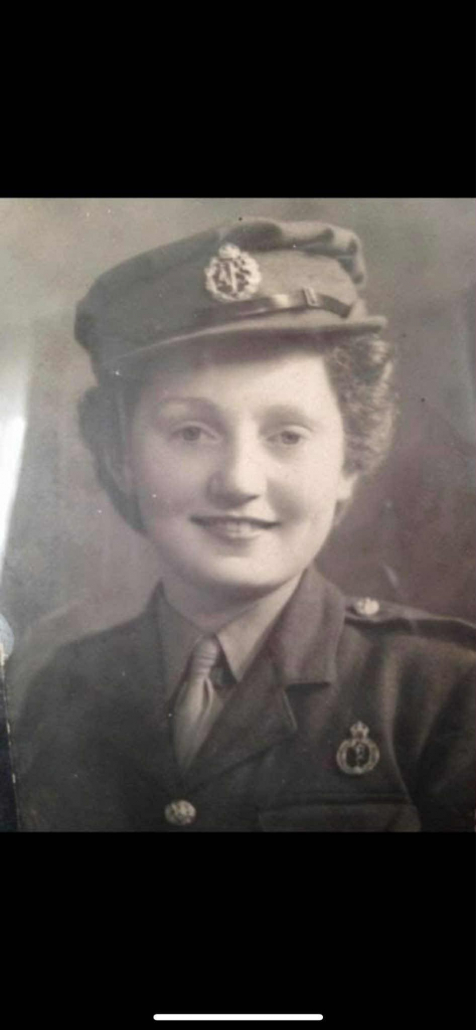
Joan Bamford served in the Auxiliary Territorial Service (ATS), proudly receiving her service badge — and wearing it with such pride. Her daughter shared:

“My Mum, Joan Bamford, served in the ATS, she received her ATS service badge and was thrilled with it, she wore it with such pride. She met my Dad, Bill Carter, when he was a Bevin Boy and they had 53 years of marriage.”

It’s a powerful reminder that service took many forms. While Joan joined the ranks of women supporting the military effort, Bill was one of the thousands of young men conscripted to work in the coal mines as a Bevin Boy — a role often overlooked, but absolutely vital to keeping the country going.

We’re proud to remember not only those who wore uniform, but also those who kept the home fires burning — in the mines, in the factories, and in the quiet strength of everyday life.

With thanks to Annette Carter for sharing her parents story

“He was a charming and good-looking man who made everyone feel welcome.”

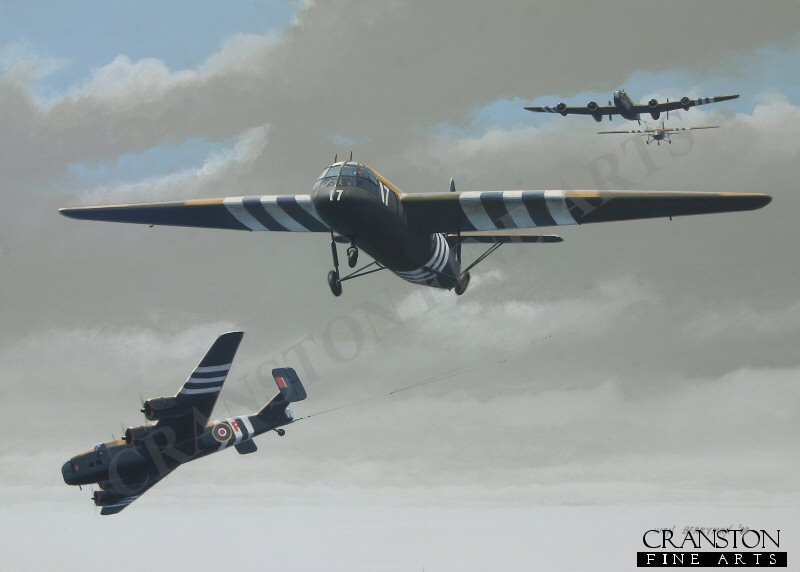
Robert Paul Lester — known to most as Paul — was a beloved figure in Wotton-under-Edge and a true war hero. As a young man, he served in the Royal Engineers during World War II and was part of a daring glider mission into France the day after D-Day. Flying in a wooden glider under cover of darkness, Paul and his fellow soldiers landed behind enemy lines to support the Allied advance — a mission that required extraordinary courage and precision.

After the war, Paul returned to Wotton, where he lived in Adey’s Lane with his wife, Jean. The couple were married for nearly 70 years, and Paul was known for his warmth, wit, and deep love for his community.

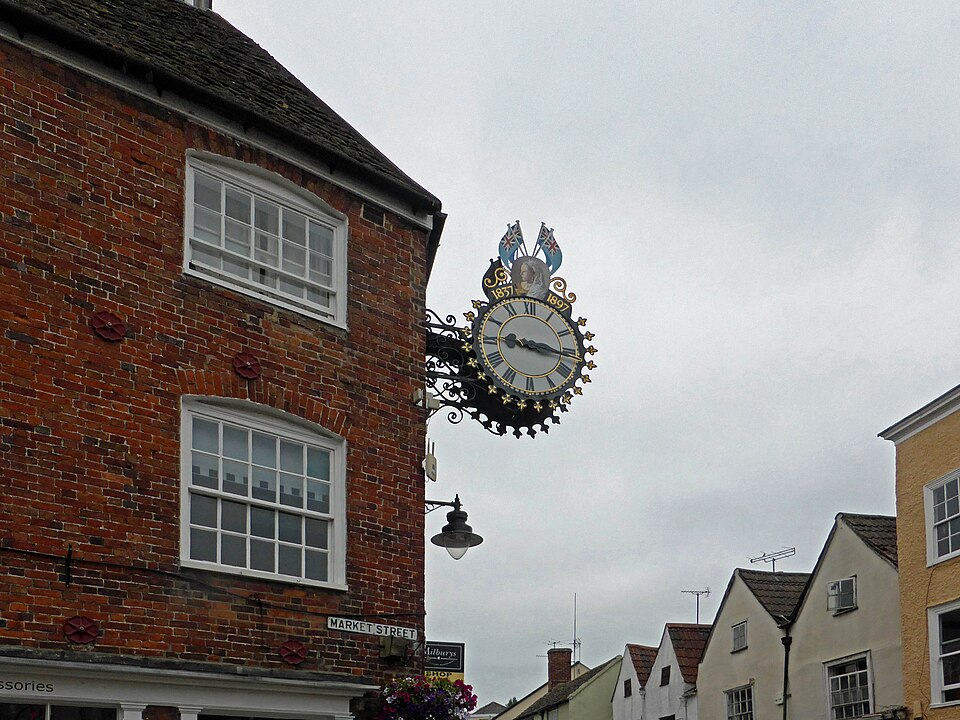
Beyond his military service, Paul was a skilled engineer and took great pride in maintaining the Wotton-under-Edge Town Clock, ensuring it kept perfect time for decades. His quiet dedication to this task became a symbol of his character — steady, reliable, and always in service to others.

Paul passed away peacefully at the age of 98, just one month shy of his platinum wedding anniversary. His legacy lives on not only in the stories of bravery from Normandy, but in the ticking of the town clock and the hearts of those who knew him.

Arthur Thomas Fowler

Arthur Thomas Fowler was born in Charfield in April 1896, the youngest child of Thomas and Emily Fowler (née Workman). He grew up with four siblings—George, Albert, Mabel and Leah—and a stepsister, Ellen Workman.

Early Life in Charfield

The 1901 Census places the family at No. 32 The Station, a small dwelling likely situated behind what is now the Railway Tavern car park. Arthur’s father worked as a plasterer, while his older sisters, Mabel and Leah, were employed in the local mills. By this time, his stepsister Ellen had married Alfred Calas and moved to London.

Tragedy struck the family later that year when Arthur’s father died in October 1901. He was buried at St James’s Churchend, though the exact grave location is unknown. Arthur’s sister Leah died in 1908 at just 24, and she too was buried at St James’s without a marked grave.

By the 1911 Census, Emily, Mabel, Albert and Arthur were still living together in the modest four‑room house behind the Railway Tavern. All three siblings were working as millhands, almost certainly at Tubbs Lewis & Co. at New Mill. Arthur’s older brother George may already have enlisted in the military by this time, though records are unclear due to several men of the same name in the area.

Enlistment and Service

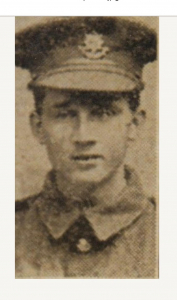
When Britain declared war on Germany on 4 August 1914, Arthur was among the first young men from Charfield to volunteer. He enlisted on 3 September at Wotton‑under‑Edge, with his papers signed by Stanley W. Tubbs, owner of the mill where Arthur worked.

He joined the 10th Battalion, Worcestershire Regiment (Army No. 18677). Because local regiments were already full, it was common for recruits to be assigned further afield.

In March 1915, the battalion assembled at Tidworth. On the night of 18–19 July, Arthur and the rest of the 10th Battalion crossed from Folkestone to Boulogne. Through July and August they underwent intensive training alongside experienced troops on the French–Belgian border in the Nord–Pas‑de‑Calais region. In early September they spent ten days holding the front‑line trenches before returning to reserve positions.

Wounding and Declining Health

On 7 January 1916, while serving in the trenches at Neuve Chapelle, Arthur was shot in the left side. This wound ended his active service—and ultimately his life.

Regimental records show that between 4 January and 17 April 1916, the 10th Battalion suffered 5 killed and 10 wounded. Arthur was among the wounded.

He was treated first at a Field Ambulance station, then transferred on 16 January to the Casualty Clearing Station at Calais. On 19 January he was evacuated to England aboard the hospital ship Stad Antwerpen. By then he had served three years.

Back in England, Arthur was moved to the 5th Battalion, Worcestershire Regiment, a special reserve unit responsible for training new recruits and caring for convalescing soldiers. His health, however, continued to deteriorate. In October 1916 he was medically discharged as unfit for further service, his condition directly attributed to his wartime injuries.

Doctors believed he might recover within nine months, but Arthur never regained his strength.

Death and Burial

Arthur died on 24 November 1916 at Bristol General Hospital, just over a month after his discharge. His death certificate records a twisted gut but does not link his death to his war wounds. Because of this omission, he does not qualify for a Commonwealth War Graves Commission (CWGC) headstone.

He was buried at St James’s Church, Charfield. His grave location is now lost. A wooden soldier’s marker would have been placed at the time, but the family could not afford a permanent stone. Only the metal plaque from that marker survived, rediscovered by relatives around twenty years ago.

His service record notes his “very good conduct,” and he was awarded the Silver War Badge, issued to honourably discharged soldiers to protect them from accusations of cowardice.

Rediscovery and Commemoration

Over the years, local historians repeatedly petitioned the CWGC and the Ministry of Defence to review Arthur’s case, but each request was refused due to the wording on his death certificate.

In March 2024, a local Army veteran—serving as Charfield’s Royal British Legion Standard Bearer and a volunteer with the Friends of St James—researched the names on the village war memorial and uncovered Arthur’s forgotten story. Determined to honour him properly, she launched a fundraising campaign to place a headstone near his mother’s grave as a permanent tribute.

In June 2024, a distant relative contacted the Friends of St James with new family items:
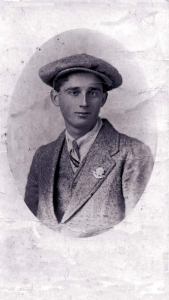
• a photograph of Arthur proudly wearing his Worcestershire Regiment badge after discharge
• the metal grave plaque
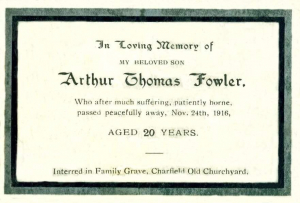
• his funeral memorandum card stating he was buried in the family grave

Although his father Thomas was buried at St James’s, no record of that plot survives. His mother Emily’s grave, however, is known.

Newspaper clippings from 1916 reveal the deep sense of loss felt in Charfield. Arthur had been one of the first local men to enlist.

A New Memorial for Arthur

The community responded to the fundraising campaign with remarkable generosity. Supporters from Charfield and beyond raised the £2,500 needed for the memorial.

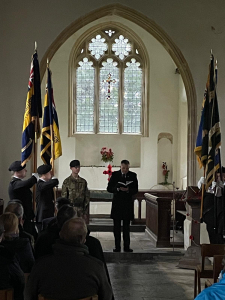
In November 2024, 108 years after his death, a special commemoration service was held at St James’s Church. Seven Standards were present, including that of the Worcestershire and Sherwood Foresters—successors to Arthur’s own regiment. Local veterans, Army Cadets, and members of the community gathered as a military padre led a service celebrating Arthur’s life and sacrifice.