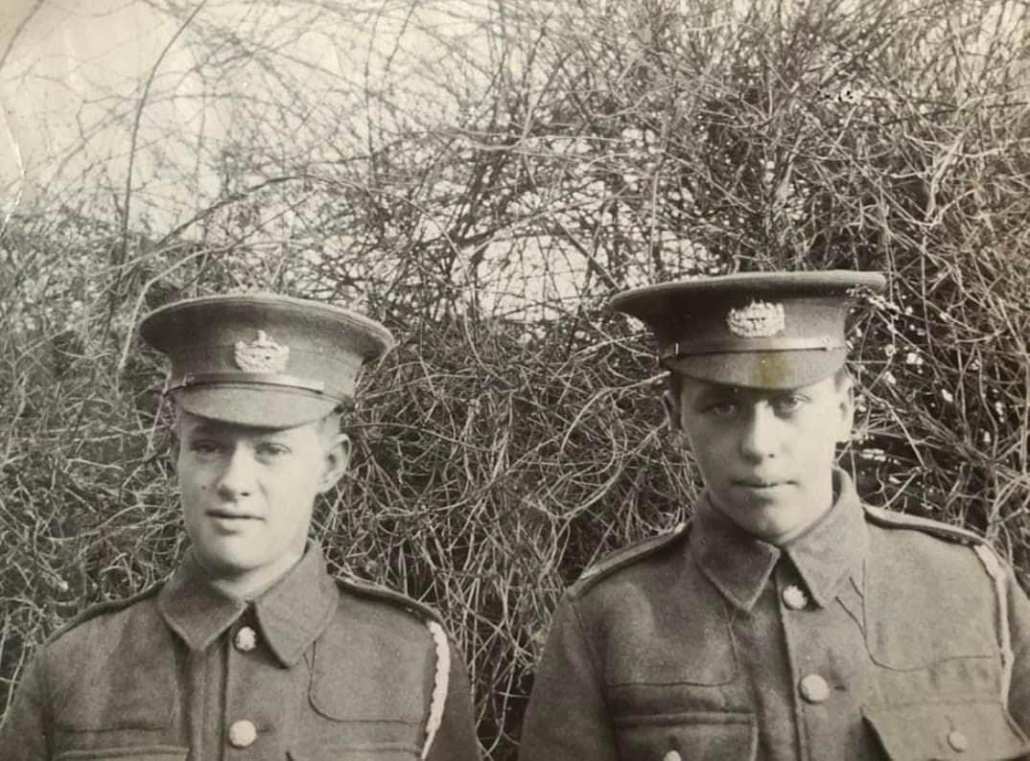
Albert and Harry HUGHES – Charfield
17778 Private Albert Alexander HUGHES
17777 Private Harry HUGHES
2ndBattalion (A Company), Gloucestershire Regiment
Aged 18 and 19.
Killed in action on 9 May 1915
No known grave–commemorated on the Menin Gate Memorial to the Missing
The stories of the Hughes brother are virtually inseparable. Albert Alexander, known as ‘Alex’, was the elder of the two, having been born in Paddington, London in 1896. Harry was born at Chelsea, London in the following year. They were the sons of George A and Annie E Hughes (nee Harding) of The Wye, children and had six other siblings.
Prior to enlisting in the Army in January 1915 both were mill hands. Their Army numbers are consecutive which indicates they both signed up at almost exactly the same time. It is likely that one or both lied about their age, in order to avoid being held back in the UK until they were 19.
They were posted the 2nd Battalion of the Glosters, which had been sent to join the BritishExpeditionary Force (BEF) in France in mid December 1914. The Hughes boys arrived in France on Good Friday, 2 April 1915, as part of a draft to replace casualties. They were both assigned to ‘A’ company.
In late April the 2 nd Glosters were deployed just south of the Menin Road, near to the village of Hooge, in what was known as ‘The Ypres Salient’ in the front line, facing the Germans in Herenthage Wood. The town of Ypres had tremendous strategic importance and was subjected to heavy fighting throughout the Great War. Its importance lay in the fact that it if it fell the route to the Channel ports, vital to thesupply of BEF, would be open to the Germans.
During April and May 1915 the Germans mounted a series of attacks in the Ypres Salient, which formed part of what became known as The Second Battle of Ypres. By 9 May the British units had been forced to give ground and were entrenched on the eastern edge of Sanctuary Wood, facing a German strongpoint named Stirling Castle. Both 8 and 9 May had seen the British subjected to heavy artillery bombardment and heavy fighting ensued. It is possible that the Hughes brothers took part in a British counter attack which went in at 3.30pm on the 9th, which was subjected to heavy machine gun fire from parts of Sanctuary Wood and Stirling Castle. On the 9th the 2ndGlosters lost 5 officers and 140 other ranks, killed wounded or missing. It is almost certain that the Hughes brothers were part of the 140. The Dursley Gazette reported that one of their comrades sent a letter to his parents in Wotton-under-Edge in which he spoke of ‘seeing the Hughes boys bowled over’ which was conveyed to the boys’ parents in Charfield.
The Hughes brothers enlisted, served and died together on the same day. If their bodies were recovered they were probably buried locally, only to be disturbed in the subsequent fighting in the area. They are commemorated, together, on the panels devoted to the Gloucestershire Regiment located on the Menin Gate Memorial to the Missing of the Ypres Salient.
Their brothers Joe and George Hughes also served in the Great War (with the Army Service Corps and Glosters, respectively) and survived.
The idea of a Charfield memorial was first raised by their brother, Joe, in early February 1919, in a letter to the local newspaper. The village Parish Council took up the administration of the task and a committee was set up to gather subscriptions for costs and the manage the work itself. The final cost was around £200 (around £6500 today).
Work on building the Memorial commenced soon after, with Mr W. T. Goscombe, a local contractor being employed. The centre piece took the form of a Portland stone Gloucester Cross, with the names of the fallen inscribed at the base. Panels on the surrounding wall listed the names of others who served.
Although completed at the end of September 1919, the formal dedication did not take place until 2.45 pm on 28th February 1920. A large crowd gathered. Amongst it were many relatives of the fallen, who were later to place floral tributes. Over the Cross was draped a large Union Flag and the task of removing this was given to Frances Beatrice Neal, the only child of the village rendered fatherless by the War – her father went down with HMS Monmouth at the Battle of Coronel in November 1914.
Thanks to Alexis Threlfall, Graham Adams and others for the information in this and photographs.
Leave a Reply
Want to join the discussion?Feel free to contribute!