
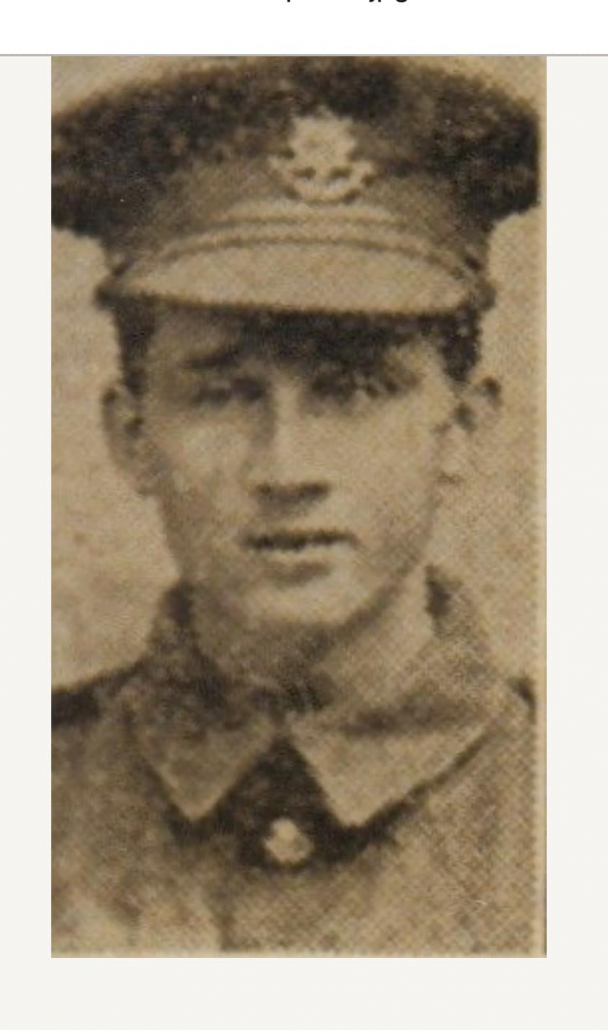
Pte Arthur FOWLER – Charfield
Arthur Thomas Fowler
Arthur Thomas Fowler was born in Charfield in April 1896, the youngest child of Thomas and Emily Fowler (née Workman). He grew up with four siblings—George, Albert, Mabel and Leah—and a stepsister, Ellen Workman.
Early Life in Charfield
The 1901 Census places the family at No. 32 The Station, a small dwelling likely situated behind what is now the Railway Tavern car park. Arthur’s father worked as a plasterer, while his older sisters, Mabel and Leah, were employed in the local mills. By this time, his stepsister Ellen had married Alfred Calas and moved to London.
Tragedy struck the family later that year when Arthur’s father died in October 1901. He was buried at St James’s Churchend, though the exact grave location is unknown. Arthur’s sister Leah died in 1908 at just 24, and she too was buried at St James’s without a marked grave.
By the 1911 Census, Emily, Mabel, Albert and Arthur were still living together in the modest four‑room house behind the Railway Tavern. All three siblings were working as millhands, almost certainly at Tubbs Lewis & Co. at New Mill. Arthur’s older brother George may already have enlisted in the military by this time, though records are unclear due to several men of the same name in the area.
Enlistment and Service
When Britain declared war on Germany on 4 August 1914, Arthur was among the first young men from Charfield to volunteer. He enlisted on 3 September at Wotton‑under‑Edge, with his papers signed by Stanley W. Tubbs, owner of the mill where Arthur worked.
He joined the 10th Battalion, Worcestershire Regiment (Army No. 18677). Because local regiments were already full, it was common for recruits to be assigned further afield.
In March 1915, the battalion assembled at Tidworth. On the night of 18–19 July, Arthur and the rest of the 10th Battalion crossed from Folkestone to Boulogne. Through July and August they underwent intensive training alongside experienced troops on the French–Belgian border in the Nord–Pas‑de‑Calais region. In early September they spent ten days holding the front‑line trenches before returning to reserve positions.
Wounding and Declining Health
On 7 January 1916, while serving in the trenches at Neuve Chapelle, Arthur was shot in the left side. This wound ended his active service—and ultimately his life.
Regimental records show that between 4 January and 17 April 1916, the 10th Battalion suffered 5 killed and 10 wounded. Arthur was among the wounded.
He was treated first at a Field Ambulance station, then transferred on 16 January to the Casualty Clearing Station at Calais. On 19 January he was evacuated to England aboard the hospital ship Stad Antwerpen. By then he had served three years.
Back in England, Arthur was moved to the 5th Battalion, Worcestershire Regiment, a special reserve unit responsible for training new recruits and caring for convalescing soldiers. His health, however, continued to deteriorate. In October 1916 he was medically discharged as unfit for further service, his condition directly attributed to his wartime injuries.
Doctors believed he might recover within nine months, but Arthur never regained his strength.
Death and Burial
Arthur died on 24 November 1916 at Bristol General Hospital, just over a month after his discharge. His death certificate records a twisted gut but does not link his death to his war wounds. Because of this omission, he does not qualify for a Commonwealth War Graves Commission (CWGC) headstone.
He was buried at St James’s Church, Charfield. His grave location is now lost. A wooden soldier’s marker would have been placed at the time, but the family could not afford a permanent stone. Only the metal plaque from that marker survived, rediscovered by relatives around twenty years ago.
His service record notes his “very good conduct,” and he was awarded the Silver War Badge, issued to honourably discharged soldiers to protect them from accusations of cowardice.
Rediscovery and Commemoration
Over the years, local historians repeatedly petitioned the CWGC and the Ministry of Defence to review Arthur’s case, but each request was refused due to the wording on his death certificate.
In March 2024, a local Army veteran—serving as Charfield’s Royal British Legion Standard Bearer and a volunteer with the Friends of St James—researched the names on the village war memorial and uncovered Arthur’s forgotten story. Determined to honour him properly, she launched a fundraising campaign to place a headstone near his mother’s grave as a permanent tribute.
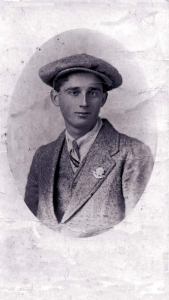
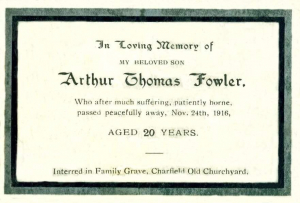
In June 2024, a distant relative contacted the Friends of St James with new family items:
• a photograph of Arthur proudly wearing his Worcestershire Regiment badge after discharge
• the metal grave plaque
• his funeral memorandum card stating he was buried in the family grave
Although his father Thomas was buried at St James’s, no record of that plot survives. His mother Emily’s grave, however, is known.
Newspaper clippings from 1916 reveal the deep sense of loss felt in Charfield. Arthur had been one of the first local men to enlist.
A New Memorial for Arthur
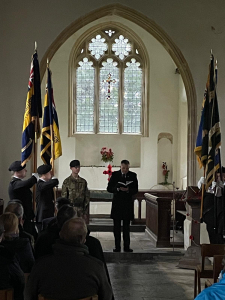
The community responded to the fundraising campaign with remarkable generosity. Supporters from Charfield and beyond raised the £2,500 needed for the memorial.
In November 2024, 108 years after his death, a special commemoration service was held at St James’s Church. Seven Standards were present, including that of the Worcestershire and Sherwood Foresters—successors to Arthur’s own regiment. Local veterans, Army Cadets, and members of the community gathered as a military padre led a service celebrating Arthur’s life and sacrifice.
Leave a Reply
Want to join the discussion?Feel free to contribute!